

Thursday, April 22, 2010
Cornell Cooperative Extension at Diven School
Students at Diven Elementary School were treated to a program presented by Toni Gardner and Anne Hughes from the Cornell Cooperative Extension. Toni and Anne talked to children about the water cycle, water usage and water conservation. Students were given much fascinating and surprising, information designed to impress upon them the need to preserve our precious resources. The video and photos below tell the story!


Thursday, March 25, 2010
Covering Big Flats
Students in Danielle Aepelbacher's class recently refined the book covers they made during Annemarie Zwack's residency in January.


Annemarie Zwack worked with CRSP students on making handmade books. She first read her own book entitled "Color Me Earth" outloud to the class and noted the illustrations she made with cloth and paint. As "Color Me Earth" is told from the point of view of the Earth, she then asked students if they knew who was speaking in the book, and asked them about the cycles that they may have noticed (the water cycle, and the decomposition of a tree that in turn feeds the earth).
Students also discussed "What is an Artist" and talked about how an artist can find inspiration. Zwack draws inspiration from topics she feels strongly about, and even materials that support her ideas are all sources of inspiration for me.
The Chemung River, of course, was the topic for this project. Annemarie wanted students to think about the role the Chemung River (or water) plays in our lives? "Will we always have access to free clean drinking water? Does anything threaten our clean water supply? Does everyone on the planet have clean water to drink? Why? What do you think it will be like in the future? Is there any substitute for water?"
Students then made their own books which will be on display in May at the Arnot Art Museum!
The stated purpose of the project was to 1) increase awareness of the work of contemporary artists, 2) to enhance students' understanding of the role artists play in the larger socio-political cultural sphere, 3) to increase awareness of the importance of research in the work of many contemporary artists, 3) 5o enhance students' understanding of water conservation 4) to enhance critical thinking skills 5) o introduce the concept of collaboration and community in making art 6) o introduce to students basic graphic design skills 7) to introduce to students the many ways in which the arts intersect with other areas of the curriculum, 8) to demonstrate to students the common threads linking art made in the past with contemporary art.
Annemarie noted that contemporary artists find inspiration in the world around them, just as the Hudson River School of painters was inspired by water and their environment.


Friday, November 13, 2009
Introducing Rhonda Morton in December!
In December, Rhonda Morton will be visiting the schools to introduce Chemung River School students to haiku poetry and to discuss seasonable changes. Students will refer to their journals full of notes taken during the autumn riverwalks with Tanglewood Nature Center educators and the poet, Sue Heavenrich. (See the post below).
Rhonda is new to CRSP, but she brings lots of experience as a writer, poet and improvizational performance artist to the program. She has taught children and adults of all ages. Check out the link to an educational children's television program - Move it! - on which she recently appeared!

Rhonda Morton is a poet, performance artist, dancer and singer with a particular interest in improvisation in all those roles. In 2005, Rhonda formed Alligator Mouth Improv, a four-person ensemble that draws on theatre, movement, vocals, music and storytelling, all created in the moment, often from audience input and interaction. Rhonda is the author of two books of poetry -- Woman Seeking Water (FootHills Publishing, 1997) and Breathing In, Breathing Out (FootHills Publishing, 2001) -- as well as a book of short-short stories, She Opens the Suitcase (FootHills Publishing, 2009). She is a poet of the stage as well as the page, and has been the featured reader at venues throughout the Northeast since her first performance on the Centerway Bridge in Corning, NY, in 1992.
Rhonda is also a skilled workshop facilitator and has worked with groups of every type -- from pre-schoolers to trust bankers -- to open up the potential and harness the creativity in individuals and groups.
In addition, she is certified as a leader of InterPlay, an improvisation-based approach to personal and organizational effectiveness practiced around the world, and she conducts creative writing workshops for adults and teens. In 1997, she founded GirlSmarts®, a series of workshops and retreats that use the arts to help teenage girls understand who they are and what they want out of their lives. In 2005, Rhonda was awarded the Arts Partnership Award from The ARTS Council of the Southern Finger Lakes for "tirelessly supporting others in their artistic endeavors, for encouraging young poets and musicians, and mentoring young women with her passion for and commitment to the arts."
Teachers, mentors and major creative influencers include Chemung River School Project poet, Michael Czarnecki, Martin Keogh, Bonnie McCubbin, Phil Porter, Rhiannon, Owen Walker, Sarah Williams, and Cynthia Winton-Henry.
Native American Arts and Crafts at the Chemung Valley History Museum
 Karen Gilpin assisted in presenting the Native American program at the Chemung Valley History Museum in November. She offered crafts instruction to 4th grade students. Boys made dream catchers whilst girls made dolls. Many parents were on hand to assist!
Meanwhile, Joan Neece introduced the children to the music and legends of the Native Americans who lived in this region.


Monday, October 12, 2009
Diven Students visit the Tanglewood Nature Center
Tanglewood Nature Center naturalist and educator, Ian McLaughlin, gives Diven Elementary School students a tour of the grounds at Tanglewood Nature Center. More pictures and a video to come later!


CRSP at the Wyncoop Creek!
 Sue Smith Heavenrich with 4th grade students from Chemung Elementary School as they "listen intently for nature's sounds." To learn more about Sue and her program, see the October 6, 2008 post entitled
 The students are eager to pay attention to the environment with all their senses. They will write about their experiences in their journals.

Their teacher, Jeanne Gridley, actively engages her students in the presentation.
Many parents are also present as they chaperone the class.

Jean Schultz poses with her daughter, Ashley who says the riverwalk is "really fun!"

J.D. displays a "baby banana slug" she found.
 Lisa LaRock stands with her sons, Michael and Matt. Matt was happy to report that he was learning about "a whole bunch of creatures and creeks!"

Carrie Parker and Marcella B. spot something in the water
 CRSP naturalist and artist, Sue Heavenrich, points out a water strider to Vinnie.

Mrs. Talada with her son, Dewain.
Jeanne Gridley, Mrs. Talada and Mrs. Schultz discuss the many merits of the riverwalks with the Chemung River School Project.
Wednesday, July 22, 2009
Riverfest!
The Arnot Art Museum sponsored a Riverfest featuring the arts and crafts of regional artists. Students who had participated in the Chemung River School Project had work they created throughout the year on display at the Arnot Art Museum and the Chemung Valley History Museum for a wonderful culmination to an educational and exciting year both inside and outside the classroom. As always, the Chemung River was, and will continue to be, the pivot around which the program revolves and the inspiration for our teaching artists and naturalists. Preservation of the river and the waters of the world is part of the mission of CRSP.

We at the Arnot Art Museum remain as dedicated as ever to educating young people in all areas of the curriculum through the arts. Indeed, NY State standards in social studies, language arts, science, and the arts are satisfied through programs which have been carefully crafted through the input of museum educators, CRSP teaching artists and classroom teachers. CRSP has been nationally recognized by the NY State Council on the Arts, the Institute of Museum and Library Services and the National Endowment for the Arts. Our educators and presenters are HIGHLY educated and qualified to teach and are willing to work with your teachers to tailor the CRSP curriculum to meet the needs of regional schools. Many of our presenters, past and present, have received awards for their art and/or their teaching and we are fortunate and honored to have them working with us. Just this past year, one of our teaching artists - Damali Abrams - was granted a very prestigious fellowship with the A.I.R. Gallery in New York City. Annemarie Zwack and Diedra Krieger each continue to exhibit their work in national venues and receive awards for their work. Damali and Diedra will not be working with us this coming year, but we are happy to have Annemarie Zwack continue with us. Our writer, Sue Smith Heavenrich has been published in numerous venues and has had years of experience teaching children. Our museum educators at the Arnot Art Museum and the staff at Tanglewood Nature Center, Chemung Valley History Museum and the Cornell Cooperative Extension are, without exception, highly educated, experienced and passionate about their work. The cost of bringing these talented artists and educators into your classroom on an individual basis would be prohibitive, but is an excellent value through CRSP.
Below are examples of projects which were completed during Annemarie Zwack's January residency at Center Street School in Horseheads and Chemung Elementary School in Waverly, NY. Many teachers also included the haiku poetry created with Sue Smith Heavenrich during the winter session when she returned to the classroom to follow up their fall session during the riverwalks and to discuss, among other things, seasonal changes to the environment. Students also reflected on the journal writing they had done in the fall and practiced the art of paying attention with all their senses. Students' introduction to writing haiku poetry developed language arts skills as well as nurtured a love for literature and enhanced their appreciation for the natural environment. To read more about Sue's program, see the archive below dated and titled Monday, October 6, 2008 RIVERWALKS - SCIENCE AND LANGUAGE ARTS BY THE RIVER!

This mixed media drawing and fabric collage is called Jewels, like the accompanying haiku.
Jewels
Fishing swimming nicely
Big mountains with purple peaks
A bird flies around

Two more exemplary examples of fabric collages. Select student work was placed in frames and displayed in the front gallery at the Arnot Art Museum.


Chemung River School Spring Riverwalk!
The beautiful Chemung River as it appeared last spring.
 In May, students returned to the Chemung River with the staff at Tanglewood as well as the writer, Sue Smith Heavenrich, to observe seasonal changes and their impact on the environment. Students had honed writing skills and learned what it means to be ‘adapted” to an area and/or certain environmental conditions. They gained an idea of what an introduced species is and the effect that such species can have on natives. Concepts of adaptability were addressed and students were asked to reflect on the implications of environmental change as it related to the life and health of organisms adapted to a given ecosystem.

 Emily Hofelich-Jack, educator from Tanglewood, holds up a specimen captured from the waters of the Chemung River for all the students to examine before returning to its home.
To read more about the students' adventures during the Riverwalks, please look through the archives for the Thursday, October 9, 2008 TANGLEWOOD VISITS blog and the Monday, October 6, 2008 RIVERWALKS - SCIENCE AND LANGUAGE ARTS BY THE RIVER! entry.
Wednesday, April 29, 2009
Annemarie Zwack, Scholastics and Cornell Cooperative Extension
Annmarie Zwack presented a program to students at Center Street Elementary School in Horseheads as well as Chemung Elementary School in Waverly - one that was so successful, she will be back for the 2009/10 school year. In her teaching, as well as her personal artwork, her talent, as well as her passion for stewardship of the earth, its waters, and environment, are evident.

In the photograph below, students are holding and waving a piece of fabric which represents a river. Students were asked to recall their experiences during the riverwalks and trips to the Arnot Art Museum. Students draw on their knowledge of the Hudson River School of Art, as well as the newly introduced contemporary arts to which Ms. Zwack introduces them. Students used fabric and colored pencils to create mixed media collages with the subject of the river and ecology. To see some of these works, go to the archive entitled "Riverfest," at http://chemungriverschool.blogspot.com/2009/07/riverfest.html

Annmarie showed the students many slides including work by contemporary artists, as well as her own. She is a gifted artist who has exhibited her work nationally, and is also a published children's book illustrator. The slide below includes a page from her own children's book, "Color Me Earth."

Below is the cover to her children's book.
In the photograph below, students are holding and waving a piece of fabric which represents a river. Students were asked to recall their experiences during the riverwalks and trips to the Arnot Art Museum. Students draw on their knowledge of the Hudson River School of Art, as well as the newly introduced contemporary arts to which Ms. Zwack introduces them. Students used fabric and colored pencils to create mixed media collages with the subject of the river and ecology. To see some of these works, go to the archive entitled "Riverfest," at http://chemungriverschool.blogspot.com/2009/07/riverfest.html
Annmarie showed the students many slides including work by contemporary artists, as well as her own. She is a gifted artist who has exhibited her work nationally, and is also a published children's book illustrator. The slide below includes a page from her own children's book, "Color Me Earth."

Below is the cover to her children's book.

To read more about Annemarie, visit her web-site at http://www.zwackart.com/
We are so happy to Annemarie on board!
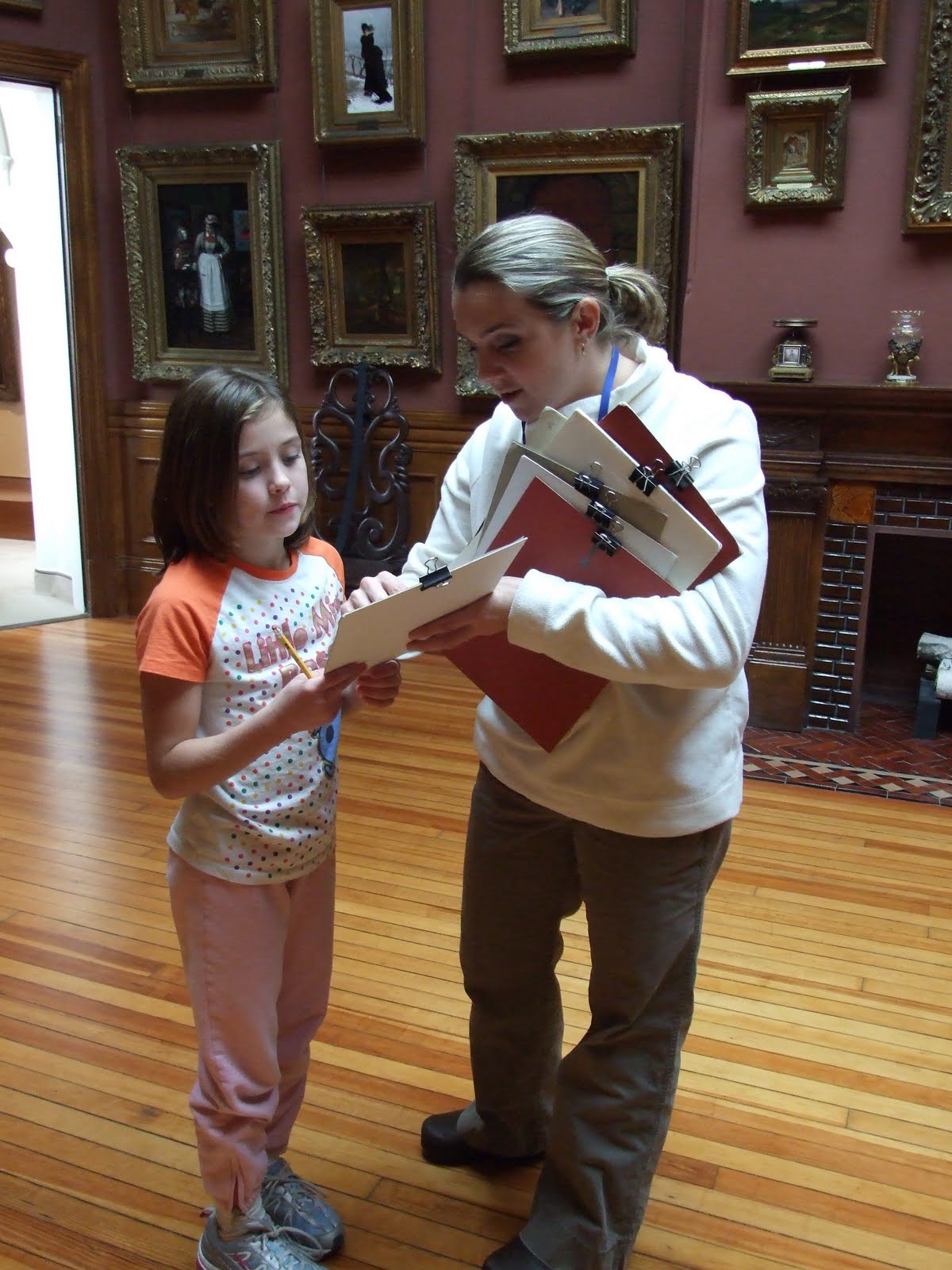
In February, students returned to the Arnot Art Museum for a tour of the Scholastics Art Show and the Chemung Valley History Museum for tours of two of their main exhibitions. The Scholastics Art Show has a long history at the Arnot Art Museum and students learned how many well-known artists got their start through this competition – some right here in Elmira. Because the artwork on display is created by people just a few years older than the students themselves, children are amazed and inspired. Comparisons are made between scholastics art and the art they remembered from the picture gallery or by the Hudson River School artists they saw in November. By this time, students are beginning to acquire some fluency in the language used in the analysis and interpretation of visual art. This tour includes hands-on activities created by museum educators. In the photograph below, museum educator, Wendy Taylor introduces students to the permanent collection in the Picture Gallery at the Arnot Art Museum. 
 In the photograph above, Amy Karastury and her students engage in activities revolving around the Scholastics exhibition.
At the Chemung Valley History Museum, students immersed themselves in a stimulating environment to learn about life in the past. They complete “exhibit encounter” packets as they moved through museum exhibits focusing on two local celebrities, Mark Twain and Floyd Woodhull.
Cornell Cooperative Extension
In April representatives from the Cornell Cooperative Extension visited the classroom introducing students to the dirty job of keeping water clean. Students were introduced to the water cycle and asked to ponder why water is so important. Emphasis was on conservation and students become more conscientious about the water we all consume and pollute daily. Hands-on activities followed a school-yard hike.
Subscribe to:
Posts (Atom)